

Fascia, Stress, and Recovery: Why Your Body Feels Tight (and What to Do About It)

We've all been there.
You wake up the morning after a tough workout and every step feels stiff. Your hamstrings are tight, your back feels locked up, and getting out of bed requires a little more effort than it should. Or maybe you've spent the day working at a desk, only to realize by evening that your shoulders have slowly crept toward your ears and your neck feels like it hasn't moved in hours.
Most people assume these sensations are simply sore muscles.
But often, there's something bigger happening beneath the surface.
The real culprit may be your fascia—a remarkable network of connective tissue that influences how you move, recover, and feel every day.
When fascia is healthy, movement feels smooth and effortless. When it becomes restricted, everyday activities can feel harder than they should, and nagging tightness can linger no matter how much you stretch.
The good news? You don't need to be a movement specialist to improve your fascial health. With the right approach, a few minutes of focused release work, and tools like the MOBO Myofascial Release Tool, you can help your body move more freely and recover more effectively.
What Is Fascia?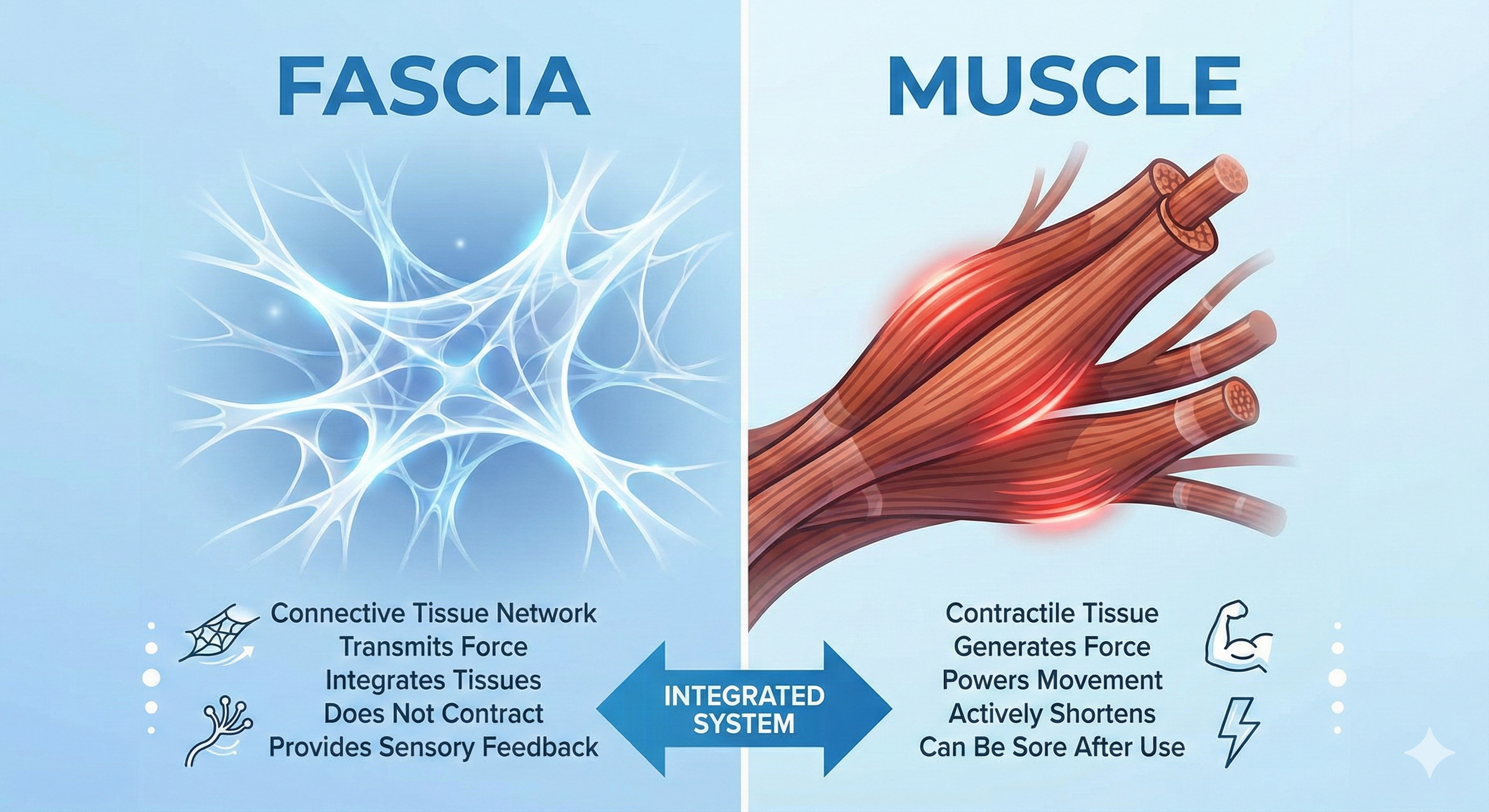
If you've ever prepared raw chicken, you've probably noticed the thin, web-like tissue surrounding the meat. That's fascia.
In the human body, fascia forms a continuous network of connective tissue that wraps around muscles, bones, nerves, joints, and organs. Rather than existing as separate pieces, it's one interconnected system running from head to toe.
Think of fascia as the body's internal support structure.
Healthy fascia is:
- Hydrated
- Elastic
- Flexible
- Able to glide smoothly between layers of tissue
When fascia moves well, your body moves well.
You can reach overhead, squat down, rotate your spine, or go for a run without feeling restricted.
Problems begin when fascia loses its ability to glide.
Long hours of sitting, repetitive movement patterns, stress, dehydration, poor recovery habits, and previous injuries can all contribute to fascial restrictions. Over time, tissues become less adaptable, and movement starts to feel stiff, sticky, or limited.
This is often the sensation people describe as feeling "tight."
In reality, the issue isn't always that a muscle is short. Sometimes the surrounding fascial system has become less mobile, creating restrictions that stretching alone can't fully address.
Why Tightness Often Returns

Have you ever stretched your hips, felt better for a few minutes, and then noticed the tightness return shortly afterward?
You're not alone.
Many people focus exclusively on stretching because it provides temporary relief. But if the underlying tissue remains restricted, the body often returns to the same pattern.
Imagine pulling on a tangled rope.
You can stretch the rope all you want, but unless you address the knot itself, the tension never truly disappears.
The same principle applies to movement.
When fascia becomes restricted, it can limit how muscles slide and function together. The body adapts by creating compensations elsewhere, often leading to recurring tightness, stiffness, or discomfort.
That's where targeted release work becomes valuable.
By helping reduce restrictions within the tissue, you create an opportunity for better movement rather than simply forcing a stretch on top of existing tension.
The Missing Piece: Your Nervous System
One of the biggest misconceptions about recovery is that it's purely mechanical.
Most people assume that if a muscle feels tight, the solution is simply more pressure.
In reality, your nervous system plays a huge role in how your body feels.
Think about what happens when you're stressed.
Maybe you're rushing to meet a deadline, sitting in traffic, or dealing with a difficult conversation.
Without realizing it, your shoulders rise.
Your jaw tightens.
Your breathing becomes shallow.
Your body prepares for a threat, even when no physical threat exists.
This response is controlled by your sympathetic nervous system, often referred to as the "fight or flight" response.
When this system stays activated for long periods, muscles and fascia can remain in a constant state of tension.
This explains why some people spend twenty minutes trying to release a tight spot and feel little improvement.
Their body is still receiving signals that it needs to stay guarded.
Before tissue can fully relax, the nervous system must feel safe enough to allow it.
Why Breathing Matters

This is where breathing becomes one of the most powerful recovery tools available.
Slow, controlled breathing helps activate the parasympathetic nervous system—the part of the nervous system responsible for rest, recovery, and relaxation.
Before using MOBO, try spending two minutes focusing on your breath.
Inhale slowly through your nose.
Exhale slightly longer than you inhaled.
Repeat for several cycles.
It sounds simple, but this small habit can dramatically change how your body responds to release work.
Many people discover that the areas they've been fighting with suddenly begin to soften once they stop bracing against the sensation.
The goal isn't to force relaxation.
It's to create the conditions that allow relaxation to happen naturally.
Why MOBO Works

Traditional recovery tools often rely on broad pressure.
While that approach can be helpful, it sometimes makes it difficult to target the specific areas that need attention.
The MOBO Myofascial Release Tool offers a more precise approach.
Its design allows you to apply focused pressure to areas of restriction while encouraging awareness of how your body responds.
Rather than aggressively rolling back and forth, MOBO encourages a slower, more intentional process:
- Identify an area of tension
- Apply comfortable pressure
- Breathe deeply
- Allow the tissue to soften
- Follow the release with movement
This combination helps create meaningful changes in both tissue quality and movement patterns.
The goal isn't simply to feel better on the floor.
The goal is to move better afterward.
A Simple Daily MOBO Recovery Routine

You don't need an hour-long recovery session to experience benefits.
Five to ten minutes can make a noticeable difference.
Step 1: Start With Breathing
Spend two minutes lying comfortably on the floor.
Focus on slow, controlled breathing.
Allow your shoulders, jaw, and abdomen to relax.
Think of this as preparing your body for recovery.
Step 2: Release Areas of Tension
Using MOBO, explore common areas that accumulate stress and restriction:
Upper Back and Shoulders
Long hours at a desk often create tension around the shoulder blades and upper back.
Spend 30–60 seconds on areas that feel restricted and combine the pressure with slow breathing.
Hips and Glutes
Whether you sit all day or train regularly, the hips often benefit from targeted release.
Use MOBO to explore the glutes and surrounding hip muscles, pausing on areas that feel particularly dense or restricted.
Quads and Hamstrings
Running, walking, cycling, and strength training all place demands on the thighs.
Spend time addressing areas that feel tight, allowing the tissue to relax gradually rather than forcing it.
Calves and Feet
The calves and feet absorb thousands of steps every day.
A few minutes of focused release can often improve comfort and movement throughout the entire lower body.
Step 3: Follow With Movement
This step is often overlooked.
Once you've completed your release work, spend a few minutes moving.
Try:
- Hip circles
- Cat-cow stretches
- Thoracic rotations
- Ankle circles
- Controlled lunges
Release creates opportunity.
Movement teaches your body how to use it.
Combining both is where lasting improvements often occur.
Recovery Doesn't Have to Be Complicated
One of the biggest mistakes people make is believing recovery needs to be complicated to be effective.
It doesn't.
The most successful recovery habits are often the simplest.
A few minutes of breathing.
A few minutes of targeted release.
A few minutes of movement.
Done consistently, these small actions can have a meaningful impact on how your body feels and performs.
Instead of waiting until you're completely stiff, sore, or uncomfortable, think of recovery as regular maintenance.
A daily five-minute practice will almost always outperform an occasional one-hour recovery marathon.
Start Small
![MOBO | 7-in-1 Mobility Tool [Buy 1 Free 1] – PFC Studio - Boutique Fitness Tool & Equipment | Online & In-store Purchase](https://cdn.store-assets.com/s/236476/i/41519931.jpg?width=1024)
Tonight, take five minutes for yourself.
Leave your phone on the counter.
Find a quiet spot on the floor.
Take a few slow breaths.
Use MOBO to explore an area that's been asking for attention—your shoulders, your hips, your calves, wherever you feel tension building.
Approach it with curiosity rather than force.
Notice what changes.
Because recovery isn't about fixing your body.
It's about listening to it.
And when you combine awareness, breathing, movement, and targeted release, you'll often discover that your body is far more capable of healing and adapting than you thought.
Your fascia is constantly responding to the signals you give it.
The question is: what kind of signals are you sending?